


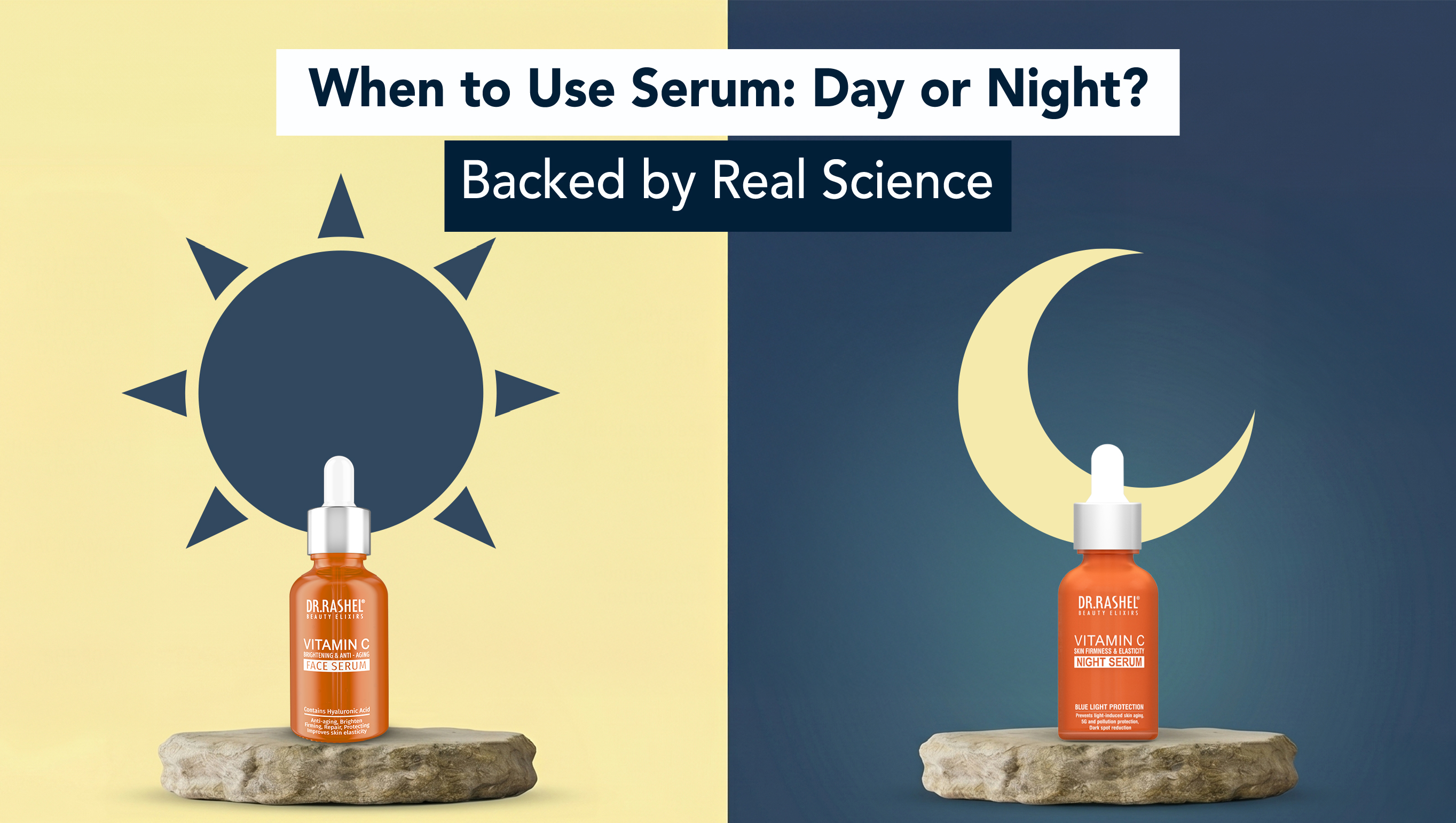
Have you ever asked yourself, “When should I use serum—DAY or NIGHT?” The answer is rooted in science, and the facts really show how important timing can be. Serums are lightweight, fast-absorbing, and designed to deliver active ingredients deep into the skin.
A 2020 study found that using serums in sync with the skin’s natural circadian rhythm (its day-and-night internal clock) led to noticeable improvements within 12 weeks, with participants reporting brighter, healthier-looking skin. (Journal of Drugs in Dermatology, 2020)
Studies like this make it clear that when you apply your serum—day or night—really matters. So, let’s dive a little deeper and thoroughly understand the science behind it.
Your Skin Has a Clock (Circadian Rhythm)
Your skin behaves differently depending on the time of day. This is not a myth—it’s a well-established concept and study.
Here we break down the daily rhythm of your skin in a simple way, showing how it behaves during the day and what changes happen at night.
According to studies, in this daily rhythm, your skin shifts into “defense mode” during the DAY, protecting itself from UV rays, pollution, and stress, and into “repair mode” at NIGHT, when it focuses on cell regeneration, DNA repair, and collagen production.
The report published in 2017 shows that skin stem cells follow a natural rhythm, meaning they switch between protection during the day and repairing it at night. This is the scientific reason why serum use day or night actually matters.
When to Use Serum in the Morning
Morning serums should protect your skin from environmental damage.
The best ingredients for daytime serums include vitamin C (ascorbic acid), niacinamide, and hyaluronic acid, as they work together to protect, strengthen, and hydrate the skin throughout the day.
What Research Actually Shows
Vitamin C (L-ascorbic acid)
How does it work?
- Neutralizes free radicals caused by UV exposure
- Reduces photodamage and pigmentation
A study demonstrated that topical vitamin C reduces UV-induced skin damage and oxidative stress.
A clinical review found that vitamin C helps improve fine lines, supports collagen synthesis, and brightens overall skin tone, making it a key ingredient for healthier, more radiant-looking skin.
These findings are among the key reasons why dermatologists often recommend applying vitamin C in the morning before sunscreen, as several clinical observations support its role in protecting and improving overall skin health.
Niacinamide
How does it work?
- Strengthens skin barrier
- Reduces oil production
- Improves uneven skin tone
A randomized clinical trial published in Dermatologic Surgery found that niacinamide led to a significant reduction in hyperpigmentation and improved skin elasticity within 12 weeks of consistent use.
Hence, niacinamide serum is considered effective for morning use, as it may support the skin’s natural circadian rhythm and strengthen its defensive function against environmental stressors.
When to Use Serum at Night
Night is when your skin enters active repair mode, making it ideal for treatment serums.
At night, the best ingredients for serums include retinol (a vitamin A derivative), AHAs/BHAs (chemical exfoliants), peptides, and hydrating serums, as they support skin repair, renewal, and recovery while you sleep.
What Research Actually Shows
Retinol (Retinoids)
How does it work?
- Increased collagen production
- Reduced fine wrinkles
- Improved skin thickness after consistent use
An in vivo clinical study found that retinol can visibly reduce wrinkles within 12 weeks, improve overall skin texture and tone, and increase collagen density, making the skin appear smoother and more refined.
Retinol is best used at night because when it is exposed to sunlight, it may deteriorate and may increase the skin’s sensitivity to UV rays.
Chemical Exfoliants (AHA/BHA)
How does it work?
- Promote cell turnover
- Improve acne and dullness
Research shows that AHAs can effectively improve skin texture, boost epidermal renewal, and help reduce pigmentation over time, which is why they are best used at night to minimize the risk of sun-related irritation and sensitivity.
Can You Use Serum Both Day & Night?
Yes, but only certain types of serums can be used both day and night. Ingredients like hyaluronic acid and niacinamide are safe for both, as they help maintain hydration and support the skin barrier. Studies in Dermato-Endocrinology show that hyaluronic acid can improve skin hydration and elasticity with regular use.
On the other hand, some ingredients are better suited for specific times. Retinol and strong acids should be used at night due to their sensitivity to sunlight, while vitamin C is best used in the morning for its antioxidant protection against environmental damage.
When to Apply Serum in Skincare Routine
The order of application directly affects how well your serum works.
Correct Routine Order
- Cleanser
- Toner (optional)
- Serum
- Moisturizer
- Sunscreen (morning only)
Common Mistakes (Scientifically Proven Issues)
Using Retinol During the Day
Leads to irritation due to UV sensitivity
Skipping Sunscreen
Studies show UV exposure reverses collagen gains from retinoids and antioxidants
Overusing Actives
Over-exfoliation can damage the skin barrier, leading to:
- Increased transepidermal water loss (TEWL)
- Irritation and inflammation
Interesting Science-Based Facts
- Skin cell turnover is 30% faster at night
- Transepidermal water loss increases during sleep, making night hydration more effective
- Combining antioxidants with sunscreen provides additive photoprotection
- Retinoids are the gold standard in dermatology for anti-aging
Final Conclusion: When to Use Serum Day or Night
In simple terms, DR.Rashel’s team concludes that morning is all about protection, using ingredients like vitamin C, hyaluronic acid, niacinamide, and other antioxidants, while night focuses on repair with retinoids and exfoliants. There isn’t a one-size-fits-all rule for serums—what matters most is using them at the right time to match your skin’s natural biological function.
Sources
Draelos, Z., Makino, E., Kadoya, K., Nguyen, A., Jiang, L., & Mehta, R. (2020). Clinical Benefits of Circadian-based Antioxidant Protection and Repair. Journal of Drugs in Dermatology, 19(12), 1209–1214.
Duan, J., Greenberg, E.N., Karri, S.S. and Andersen, B. (2021). The circadian clock and diseases of the skin. FEBS Lett, 595: 2413-2436.
Meltem Weger, Nicolas Diotel, Anne-Claire Dorsemans, Thomas Dickmeis, Benjamin D. Weger. (2017). Stem cells and the circadian clock. Developmental Biology, 431-2,
Ravetti, S., Clemente, C., Brignone, S., Hergert, L., Allemandi, D., & Palma, S. (2019). Ascorbic Acid in Skin Health. Cosmetics, 6(4), 58.
Nathan, N., & Patel, P. (2021). Why Is Topical Vitamin C Important for Skin health? - Harvard Health.
Bissett, Donald L. PhD1; Oblong, John E. PhD1; Berge, Cynthia A. BS1. Niacinamide: A B Vitamin that Improves Aging Facial Skin Appearance. Dermatologic Surgery 31(s1): 2005.
Goberdhan, L. T., Pellacani, G., Ardigo, M., Schneider, K., Makino, E. T., & Mehta, R. C. (2022). Assessing changes in facial skin quality using noninvasive in vivo clinical skin imaging techniques after use of a topical retinoid product in subjects with moderate-to-severe photodamage. Skin research and technology. 28(4), 604–613.
Almeman A. A. (2024). Evaluating the Efficacy and Safety of Alpha-Hydroxy Acids in Dermatological Practice: A Comprehensive Clinical and Legal Review. Clinical, cosmetic and investigational dermatology, 17, 1661–1685.
Papakonstantinou, E., Roth, M., & Karakiulakis, G. (2012). Hyaluronic acid: A key molecule in skin aging. Dermato-endocrinology, 4(3), 253–258.
What are the benefits of vitamin C serum? Uses and side effects. (2019).


